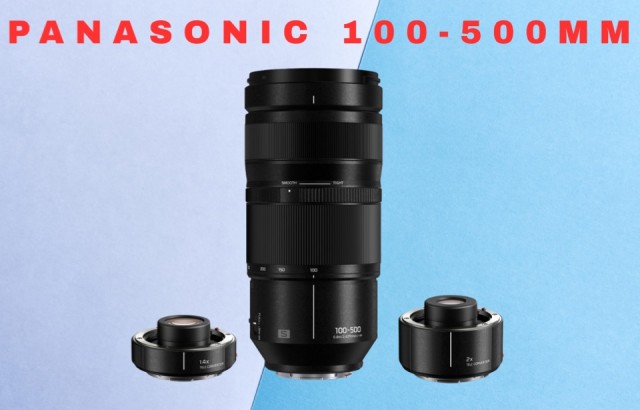
 Panasonic S 100-500mm with 1.4 and 2.0x Teleconverters
For years, Panasonic’s L-mount lenses were not the first choice for wildlife or birding. The lineup simply lacked long super-telephoto primes and zooms. Until today’s S 100-500mm f5-7.1 O.I.S. announcement, the longest native Panasonic branded option was the S 70-300 F4.5-5.6 Macro OIS, and 300mm is barely a starting point for bird photographers. L-mount shooters could fill the gap with third-party choices like Sigma’s excellent 300-600mm f4 DG OS Sports, 500mm f5.6 DG DN OS Sports, 60-600mm F4.5-6.3 DG DN OS, and 150-600mm, and even Leica’s SL 100-400 f5-6.3, but Panasonic itself seemed uninterested in this segment. The new S 100-500mm changes that. It is a step in the right direction, and we hope it signals more to come.
 New S 100-500mm seen attached to Panasonic S1 II
Also check: All Leica L-Mount Telephoto Lenses
Another win is teleconverter support. The 100-500mm works with Panasonic’s 1.4x and 2.0x TCs, pushing the long end to a 1000mm equivalent on full frame. There is a limitation after you mount a TC. The usable wide end becomes 150mm instead of 100mm. For most TC use that is not a real drawback because you are usually after the reach.
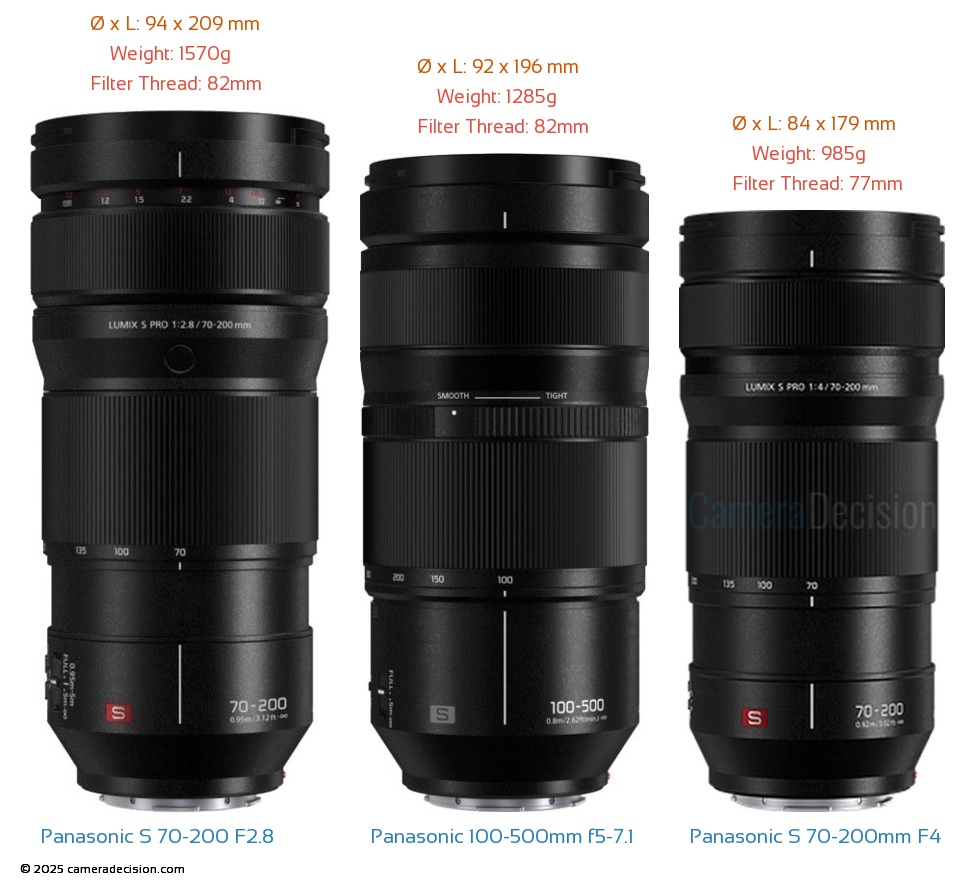 Panasonic S 70-200 F2.8 vs Panasonic 100-500mm f5-7.1 vs Panasonic S 70-200mm F4 Lenses Size Comparison
Also read: New Panasonic S 100-500mm F5-7.1 vs Canon RF 100-500mm F4.5-7.1 Lenses Size, Specs, and Price Comparison
One lingering downside is how few Panasonic L-mount lenses accept teleconverters. Even with this release the total is only three. The supported lenses are the S Pro 70-200 F2.8 O.I.S., the S Pro 70-200mm F4 OIS, and now the S 100-500mm.
Below you will find the specs for Panasonic’s L-mount teleconverters, plus a features and specs comparison for the three compatible lenses.
Effective Focal Range and Aperture with Panasonic DMW-STC14 S 1.4x TC
Effective Focal Range and Aperture with Panasonic DMW-STC20 S 2x TC
Below is a specs table for the three lenses that accept teleconverters.
Another big factor we haven’t touched on here is autofocus performance, especially subject tracking, on L-mount bodies from Panasonic, Leica, and Sigma. In general it trails comparable cameras from Sony, Canon, and Nikon. That is a large topic and outside the scope of this post, but our hope is that the L-mount makers deliver new cameras that match the class leaders, which would make these lenses far more appealing to more shooters.
