 Canon EOS R5 Mark II vs Mark I
The new Canon EOS R5 Mark II is an improvement over the EOS R5 in almost every aspect. Our detailed comparison reveals that the only area where the R5 has an edge is its slightly lighter weight. However, the Mark II comes at a significantly higher price: the R5 Mark II is priced at $4,299, while the R5 is available at a heavily discounted $2,999. So, the upgrades don't come cheap.
So, is it worth selling your R5 and upgrading to the new R5 Mark II if your priority is bird and wildlife photography? I can't make that decision for you, but I can assist by highlighting the most significant improvements in this area, and you can decide from there.
Reasons to Upgrade to the Canon R5 Mark II from the R5
1- More Usable Electronic Shutter: Thanks to the R5 Mark II's new stacked sensor, rolling shutter distortion is significantly reduced compared to the R5 when using the electronic shutter, which means you don't have to limit yourself with the 12fps max shooting speed of the mechanical shutter.
 Rolling Shutter Effect
2- No-black out viewfinder: The fast-reading stacked sensor enables a no-blackout viewfinder experience, which is helpful for tracking subjects during fast shooting scenarios such as birds in flight (BIF).
Also Read: Cameras with No-Blackout Viewfinder
 The new Viewfinder is higher resolution, brighter, and Black-out Free
3- Max Continuous shooting Speed: The max shooting speed of the Mark II at 30 fps (electronic shutter) is 10 fps faster than the R5's 20 fps. This difference may be critical in situations where you are shooting fast-moving subjects.
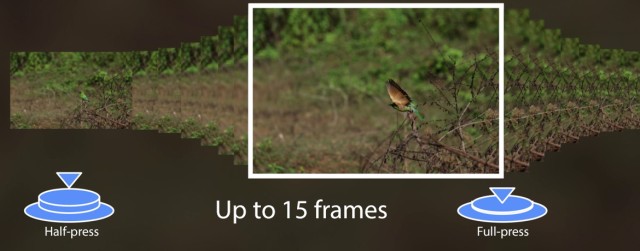 Pre-Continuous Shooting records up to 15 images before the Shutter is fully pressed
4- Pre-Burst Shooting Mode: When activated, this mode records frames 0.5 seconds before you fully press the shutter, making it an invaluable feature for bird and wildlife photographers. While the implementation on the R5 Mark II may not be the best available, as we've discussed here, it's still a significant improvement over the R5 which lacks this function.
 The new Digic Accelerator Chip Supplements the Digic X Processor
5- New and Improved AF System: It's challenging to assess just how much better the AF system on the R5 Mark II is without hands-on experience, but based on limited reviews, the new AF appears to be faster and more accurate. In fact, it is the same AF system that Canon also used in its flagship EOS R1 except for the cross-type AF sensors that the R1 has which are more sensitive in low contrast areas.
 Eye Control AF is the improved version of the system used on the EOS R3
6- Eye Controlled AF: You might consider this a gimmick, but when it works as intended, it's an excellent feature for locking autofocus anywhere in the frame which may become extremely handy for birds and wildlife. Besides, the R5 Mark II's sensor offers nearly 100% AF coverage, providing extra flexibility in choosing the focus point using the eye control feature.
 Image Stabilization is Effective up to 8.5-stops when combined with a compatible lens
7- Improved IS: Canon claims a 0.5-stop improvement in stabilization over the R5 (8.5 stops vs. 8.0 stops). Every bit of added stabilization is beneficial, especially with long telephoto lenses which are a must for bird and most wildlife photography.
8- Focus Sensitivity: The R5 Mark II can focus in lower light conditions than the original R5 (EV -6.5 vs EV -6). While the difference may seem slight, it can still significantly enhance the camera's ability to lock focus on subjects in low-light and low-contrast situations.
Conclusion
I think the new EOS R5 Mark II is a big step up from the original R5 without a doubt when it comes to satisfying the requirements of a bird and wildlife photographer, and is a worthy upgrade despite the big price difference. However, if you don't want to invest so much money in the latest and greatest, the R5 is still an excellent camera at the current price level with best-in-class image quality, and you can even score a used one close to $2000 in the US.
In my case, the R5 II impressed me so much that while I don't have an R5 (my only RF mount camera is an EOS R8 ), and my main bird photography camera is a Sony Alpha A7R V, I still did something I rarely do, and I pre-ordered the Canon EOS R5 Mark II ( 3 minutes after it was available to pre-order, I wish I was faster!) to use in parallel with my Sony system.
How about you, what do you think of the new R5 II? Are you considering buying the new Canon EOS R5 Mark II? What camera are you upgrading from? Please let us know in the comments section below!
Also Read: Best Canon RF Mount Lenses for Bird and Wildlife Photography
Canon R5 II Key Specs
- Announcement Date: 2024-07-17
- 45MP - Full frame Stacked CMOS Sensor
- ISO 100 - 51200 ( expands to 50-102400)
- Canon RF Mount
- Sensor-shift Image Stabilization( Up to 8.5-stops)
- 3.20" Fully Articulated Screen
- 5760k dot Electronic viewfinder
- 12.0fps (30.0fps Electronic) continuous shooting
- 8K - 8192 x 4320 video resolution
- 120fps High-Speed Video
- Built-in Wireless
- 746g. 138 x 101 x 93 mm
- Weather-sealed Body
- Replaced Canon EOS R5 Compare
- Read the Review
- Check Price at: Amazon, B&H Photo
