I have been a longtime Sony shooter, but I rarely stick to one mount exclusively. In the past, I have used Fujifilm X, Micro Four Thirds with Olympus and Panasonic cameras, and Nikon F mount cameras alongside my E mount cameras, but I've never owned a Canon camera for some reason. However, that's changing now. I recently bought myself a Canon EOS R8 and started to slowly test the RF mount waters. I initially purchased an RF 24-70mm F2.8 lens, which was excellent but large and heavy, and not a great match for the R8. Since I already have the Sony 24-70mm F2.8 GM, it didn't make sense to keep both. Considering the compact size of the R8, I sold the 24-70mm F2.8 and bought myself an RF 50mm F1.8 and an RF 24-105mm F4.0-7.1 IS STM to assemble a budget-friendly and compact full-frame kit.
 Canon EOS R8 and RF 50mm F1.8
Among these two RF mount lenses and one RF mount camera, the one that has impressed me the most is the EOS R8. I think Canon has a winner with the R8, which is the best full-frame camera in its price range, in my opinion. There are many aspects that I like and a few that I don't about this camera, but these are topics for a dedicated R8 review, so I won’t get into the details yet.
Canon RF 50mm F1.8 STM Key Specs
- Filter Thread: 43mm
- Max Format: 35mm FF
- 6 Elements in 5 Groups
- 1 Aspherical element , Super Spectra Coating
- Weight: 160g
- Diameter x Length: 69mm x 41
- Min Focus Distance: 0.3m
- Max Magnification: 0.25x
- Check Price at: Amazon, B&H Photo
Returning to the beginning of this review: The RF 50mm F1.8 STM. This lens is Canon's most affordable option for its RF mount. Clearly, Canon had to make significant compromises to reduce the cost of this lens. Despite its shortcomings, which we will discuss in this review, I believe it remains one of the essential lenses for the RF mount. It won't astonish you in any particular area, but the price is simply too attractive to ignore!
So, let’s start with the Pros of this lens.
Pro #1 Price
The RF 50mm F1.8 STM is incredibly affordable, with an MSRP of $199, especially when compared to the general price levels of other RF lenses. It is frequently discounted to $169, and I've seen it sell for as low as $99 new during some special sales events. By checking Canon’s refurbished product sales site or the used market, you might even find it for under $100. At this price point, the lens offers a substantial amount of enjoyment!
 RF 50mm Size
Pro #2 Size
Besides its attractive price, this lens is also very compact and lightweight for a fast F1.8 full-frame coverage lens. Here is a size comparison with Canon’s only other 50mm offering in the RF mount, the RF 50mm F1.2L USM.
 Canon RF 50mm F1.2 vs 50mm F1.8
Size-wise, the RF 50mm F1.8 pairs well with smaller RF mount bodies, including the full-frame R8. I was able to carry this combo in my coat pocket without any issues.
 Canon EOS R8 and RF 50mm F1.8 make a small combo that is ideal for street photography
Pro #3 Usable Wide Open performance
The image quality at F1.8 is entirely usable, especially in the center area. It probably won’t impress anyone with its sharpness, but for most people who don't make large prints or heavily crop their images, this won’t be an issue. Additionally, sharpness and contrast noticeably improve when stopped down to F2.8. It also represents a step up from Canon’s nifty-fifty EF 50mm F1.8 STM lens.
 Focus&Control Switch
Pro #4 Multi-function focus & control ring
The switch on the lens allows the user to use the focus ring as a customizable control ring. Considering that most people will rarely use manual focus, this feature is very handy for setting it to a frequently used setting. There are many options available in the camera menu; I have set mine to control exposure compensation.
 Ring function is customisable via Camera Menu
Pro #5 Focusing Performance
For a lens priced under $200, the focusing performance is good, although not perfect. It is fast and accurate in well-lit situations, much better than the older 50mm F1.8 lenses from the DSLR era. However, autofocus does slow down in low light but it doesn’t hunt much. Additionally, the close-up focusing capability with a maximum magnification of 0.25x is a respectable figure for this class of lens. Traditionally, non-macro 50mm lenses have had poor magnification performance, but the RF 50mm F1.8 passes this test for me.
However, there are two focusing-related issues that we will discuss in the "Cons" section.
Pro #6 Lack of Native RF mount alternatives
The RF mount is only just beginning to open up to third-party lens manufacturers (initially only for APS-C lenses), so the options at the 50mm focal length are very limited. The only other 50mm option is the Canon RF 50mm F1.2L USM, which is both large and expensive. An alternative is to use EF mount lenses via an EF to RF adapter, like the Canon Mount Adapter EF-EOS R, but this defeats the purpose of having a compact kit, and I personally have never been a fan of using adapters. Thus, the 50mm F1.8 stands as a largely unrivaled option.
Now let’s talk about the shortcomings of this lens:
Con #1 Focusing is loud and external
The STM focus motor on this lens is quite loud. This is not an internally focusing lens; the front element protrudes during focusing, and the mechanical sounds are audible. Your camera's microphone will definitely pick up these sounds, especially in quiet indoor environments.
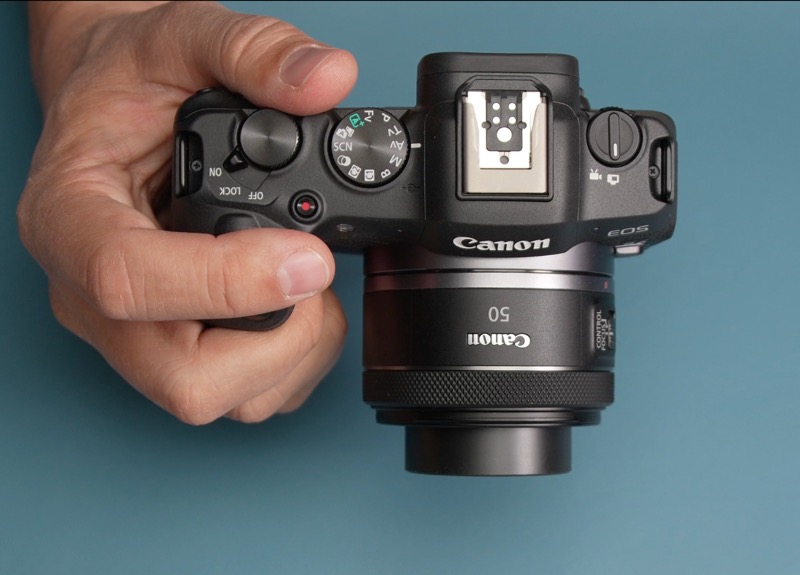 Length of the lens changes while focusing
Con #2 Strong Focus Breathing
Focus breathing can become so extreme that the RF 50mm F1.8 might be mistaken for a zoom lens! For photography, this isn't a significant issue unless you're focus stacking or require very precise framing. However, for video, it can be quite disruptive during focus pulls. Unfortunately, this lens is not one of the RF models that supports focus breathing compensation, so there's not much that can be done to correct it.
Read: Canon Lenses that Supports Lens Breathing Compensation
 Bright Light Source cause loss of contrast
Con #3 Flare and Ghosting
Canon has not employed its most advanced lens coatings or special optical elements on this lens, leading to noticeable flare and loss of contrast when there is a strong light source in the frame. Unfortunately, this issue is amplified by the next drawback (Con #4) of this lens.
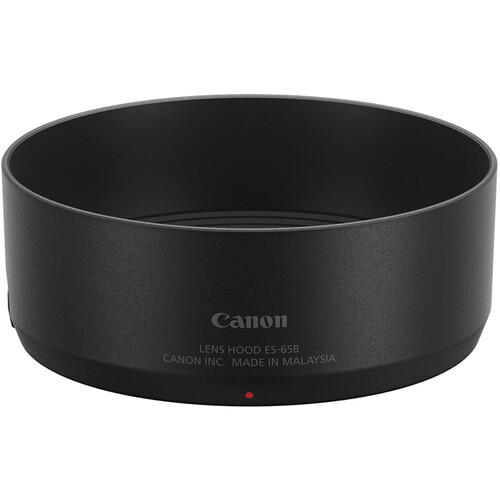 Canon ES-65B Lens Hood
Con #4 No Lens Hood Included
This issue isn’t specific to this lens alone, but it's disappointing that Canon still doesn't include lens hoods with most of its non-L series lenses. Without a lens hood, there's a higher risk of flaring and ghosting.
The Canon ES-65B Lens Hood is sold separately for $35, which is quite expensive for a lens priced under $200. Alternatively, the third-party Vello ES-65B is available for $13.
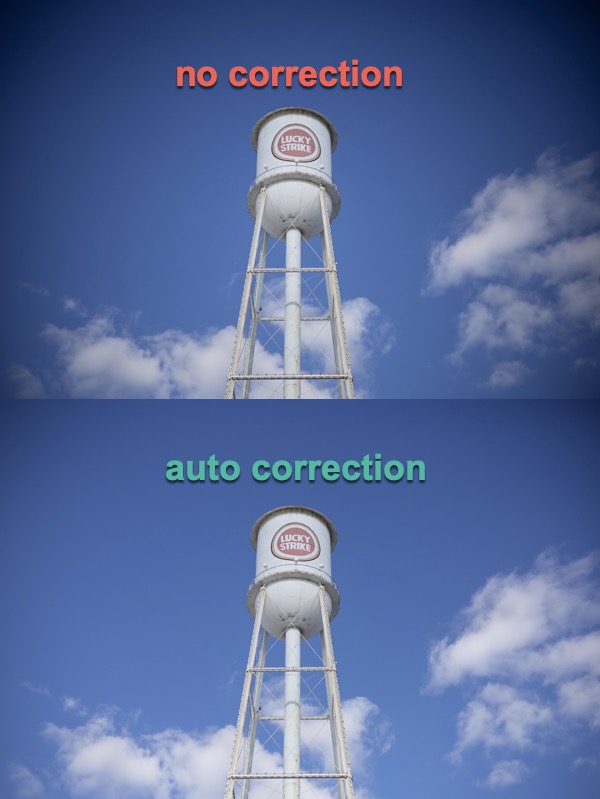 Vignetting at F1.8 - without and with autocorrection
Con #5 Vignetting
The RF 50mm F1.8 STM exhibits very strong vignetting when used wide open. While most lenses display this characteristic to a degree, the vignetting on the 50mm F1.8 is extreme! I suspect this is one of the compromises Canon had to make to keep the lens so compact. Vignetting can be corrected in-camera or in post-processing through lens profiles; however, this level of correction might introduce some artifacts in the corners of the images in extreme cases. Moreover, correcting vignetting in video footage is not as straightforward as it is in photos.
 Brick Wall Photography is a must-have!
Con #6 Image Stabilization
The RF 50mm F1.8 lacks a built-in optical image stabilization system, which is unfortunate since many people will likely use this lens with lower-end bodies like the R8, the EOS R10, and the EOS R50, none of which feature sensor-based image stabilization.
Conclusion
Despite its shortcomings, this lens is a must-have for RF mount photographers, particularly because of its compact size and low cost. You can easily toss it into your bag or even your pocket and carry it with you all day without worrying about extra weight, or the risks of damage or loss.
For videography, however, the story is different. The loud focusing motor, significant focus breathing, and strong vignetting when wide open are three major drawbacks for video shooters, and I would choose a different lens if video were my priority.
In my case, I will keep my copy and use it with my EOS R8 as a small, yet very capable and enjoyable combination that delivers great image quality.
