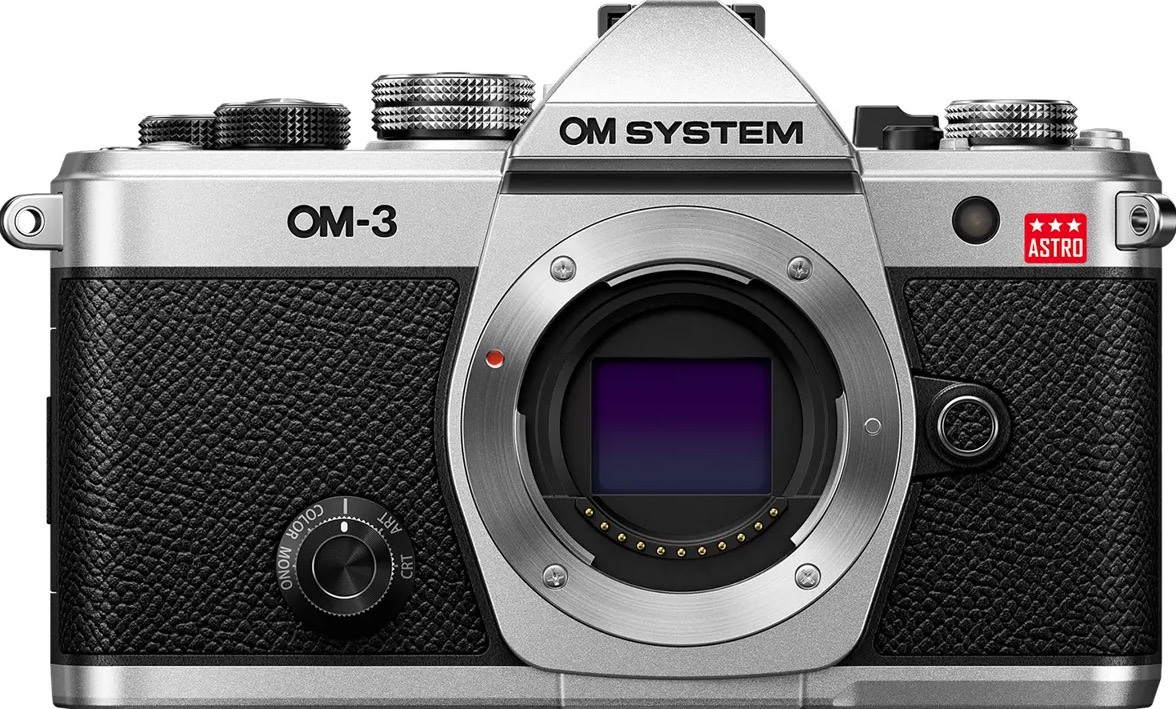
 OM System Introduces the OM-3 AstroCamera
OM System has officially announced the OM-3 Astro, a specialized mirrorless camera designed specifically for astrophotographers. Building on the core technology of the announced OM-3, this new "Astro" edition incorporates hardware and software modifications tailored to capturing the intricate details of the night sky, specifically the vivid reds of deep-space nebulae.
What Makes the OM-3 Astro Different?
While the OM-3 Astro looks nearly identical to the standard OM-3, it features several critical hardware and software changes designed for celestial imaging:
- Modified IR-Cut Filter: The most significant hardware difference is the modified infrared cut filter placed in front of the 20.4-megapixel stacked BSI sensor. While standard cameras block most Hydrogen-alpha (Hα) wavelengths to maintain natural colors for daylight photography, the OM-3 Astro allows for 100% transmission of these wavelengths. This enables the camera to capture the intense red and pink hues of emission nebulae that are usually invisible to standard digital sensors.
 OM-3 Astro Sensor
- Astrophotography Color Profiles: The camera introduces two new color profiles. COLOR1 is optimized for capturing the specific red tones of nebulae, while COLOR2 is tuned for starry landscape photography, ensuring that stars and the Milky Way pop against the dark sky.
- Dedicated Custom Modes: To streamline the shooting process, the mode dial features three pre-programmed settings (C1, C2, and C3). These are preset for in-camera stacking for deep-sky objects, stacking for starry landscapes, and handheld starry landscape shooting.
- Body Mount Filters: Alongside the camera, OM System is releasing two specialized "body mount" filters—a light pollution suppression filter (BMF-LPC01) and a soft filter (BMF-SE01). These mount inside the camera body behind the lens, making them compatible with wide-angle and fisheye lenses that typically cannot accept front filters.
Shared Flagship Features
The OM-3 Astro retains the powerful features found in the standard OM-3 and the OM-1 series (OM-1 Mark II / OM-1) . This includes the Starry Sky AF, which uses specialized algorithms to autofocus accurately on stars, and Night Vision mode, which applies a red overlay to the interface to protect the photographer's dark adaptation.
OM System OM-3 Astro Key Specs
- Announcement Date: 2026-02-10
- 20MP - Four Thirds Stacked BSI Live MOS Sensor Sensor
- No Anti-aliasing (AA) filter
- ISO 200 - 25600 ( expands to 80-102400)
- Micro Four Thirds Mount
- Sensor-shift Image Stabilization( Up to 7.5-stops)
- 3.00" Fully Articulated Screen
- 2360k dot Electronic viewfinder
- 120.0fps (120.0fps Electronic) continuous shooting
- 4K (DCI) - 4096 x 2160 video resolution
- Built-in Wireless
- 496g. 139 x 89 x 46 mm
- Weather-sealed Body
- Read the Review
- Check Price at: Amazon, B&H Photo
 OM-3 Astro Sample Image
The camera also leverages its computational photography prowess with Handheld High Res Shot. In the Astro version, this mode is used to combine 12 frames in-camera to reduce noise and increase detail—effectively performing the "stacking" process that astrophotographers usually do in post-processing—while automatically correcting for the movement of the stars.
Price and Availability
The OM System OM-3 Astro is scheduled for release in March 2026. It will be available as a body-only option for $2,499.99 in the United States and $2,999.99 in Canada. The accompanying body mount filters will also be available next month, priced at $339.99 for the light pollution filter and $229.99 for the soft filter.
